01
What an arc flash is
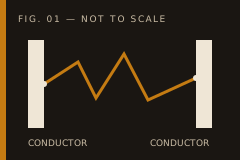
When current leaves its intended path and jumps through the air — between conductors, or from a conductor to ground — the air can become a conductive plasma. That event is an electric arc.
The light and the heat thrown off by the arc are the arc flash. A pressure wave can travel with it. People call that pressure an arc blast. The flash and the blast are products of the same event. They are not the same thing as electric shock.
Shock is current through the body. Arc flash is energy released into the space around the equipment. A person can be burned by the flash without touching a live part.
An arc can start from a tool dropped into gear, a loose or failed connection, contamination, damaged insulation, or equipment operated in a condition it was not prepared for. Naming every cause is not the point of this page. Naming the hazard is.
02
Why it matters on a plant floor
The energy in a flash can ignite clothing, damage eyes and hearing, and destroy the equipment that was supposed to stay in service. A panel that fails this way is also a production outage. The people who open that panel — electricians, and the managers who authorize the work — need a shared description of the hazard before the cover comes off.
NFPA 70E is the Standard for Electrical Safety in the Workplace. In the United States it is the consensus document most employers use to decide when energized work is justified, how far back to stand, what an equipment label should say, and what protective clothing matches the method they chose. OSHA expects employers to protect workers from recognized electrical hazards. 70E is how many programs spell that duty out. This page does not reprint the standard, and reading it here does not make a program compliant.
Labels go stale. A breaker setting, a transformer, or a tie that changed after the study can change the energy at the equipment. The date on the label is part of the label.
03
What a site assessment covers
An arc-flash assessment is a look at a specific electrical system by a qualified person. In plain language, the work usually answers the questions below. It does not answer them the same way for every plant, and this page does not do that work.
-
What equipment is in scope. Switchgear, motor control centers, panelboards, disconnects, and the feeders between them. The one-line diagram is the map. If the map is wrong, the label is wrong.
-
How much current can flow, and how fast it is stopped. Available fault current and the clearing time of the device upstream both change how much energy an arc can release. A faster trip is not a slogan. It is one of the inputs.
-
Where the arc-flash boundary sits. The boundary is a distance. Inside it, an unprotected person could receive a second-degree burn if an arc occurred under the method the assessor used. NFPA 70E ties that threshold to 1.2 cal/cm². The distance is calculated for that equipment. It is not a universal number you can copy from another plant.
-
How the label chooses protective clothing. One accepted method estimates incident energy at a stated working distance. Another uses the arc-flash PPE category tables in NFPA 70E, which apply only inside the fault-current and clearing-time limits those tables set. The two methods are not mixed casually on one label. Ask which method was used.
-
Shock boundaries, kept separate. The limited approach boundary and the restricted approach boundary deal with shock, not with the flash. NFPA 70E dropped the older prohibited approach boundary years ago. Workers face both shock and arc flash. A useful label does not pretend they are one distance.
-
A label on the gear a person actually opens, and a reason to revisit it. The label should carry the data the chosen method requires, and a date. The assessment should say what system change would make that date obsolete: a new protective device, a changed setting, a different utility contribution, a tie thrown the other way.
This site will not calculate incident energy, prepare a label, stamp a drawing, or take on engineering work for a facility. Commission that from a qualified person or a firm that is allowed to offer it where the equipment sits. Use this page to know what to ask: what method, what working distance, what date, and what has changed since.
That mailbox is a placeholder. It is not receiving mail yet. Do not send one-lines, fault studies, or other facility information to it.
There is no phone number and no street address on this site, on purpose.